SCOTUS: Post Ruan Challenge Heads to SCOTUS
Insights from White Collar Criminal Defense Attorneys Trusted Nationwide
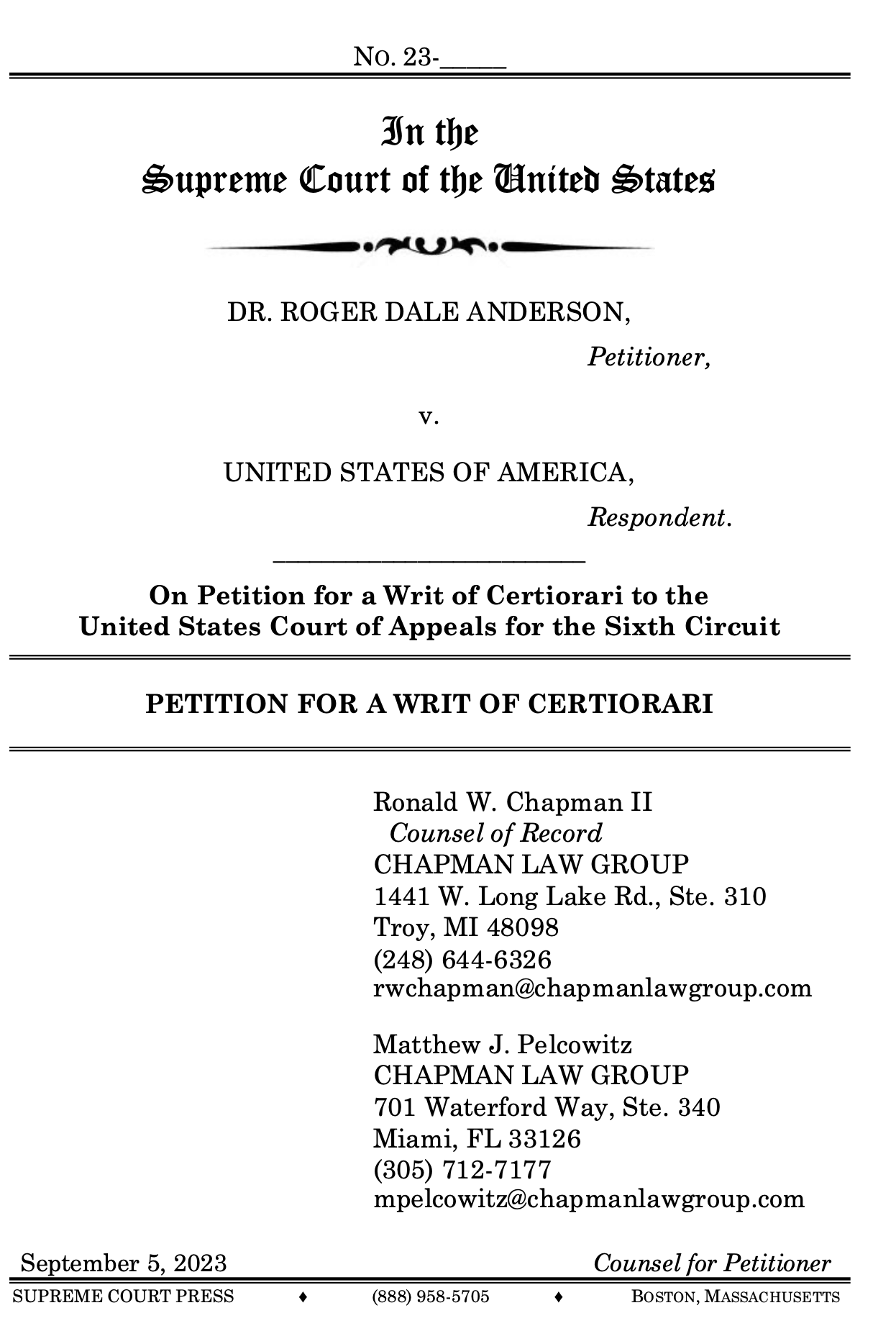 Federal Criminal Defense Attorneys Ronald W. Chapman II and Matthew Pelcowitz filed a Petition for Certiorari before the Supreme Court of the United States on behalf of infectious disease specialist Dr. Roger Anderson. Click on the image to review the brief.[/caption]
The groundbreaking Supreme Court ruling of June 2022 regarding opioid prescribing was hailed as a potential turning point for physicians facing prosecution. However, as time passed, it became apparent that the circuit courts were interpreting the unanimous opinion in divergent ways, leaving imprisoned doctors without the relief they had hoped for. Dr. Roger Dale Anderson, an infectious disease physician, joined by his appellate counsel Ronald W. Chapman II and Matthew Pelcowitz, made the decision to take his case to the high court.
Dr. Roger Anderson had a dual practice in Marietta, Ohio, serving both Marietta Memorial Hospital’s patients with severe infections and maintaining a general practice where he occasionally treated individuals with chronic pain complaints. Trouble began in 2015 when the DEA received a tip from a local pharmacist. The pharmacist had noticed that Dr. Anderson occasionally treated patients who had been discharged from other medical practices. It’s worth noting that there is no federal standard, rule, regulation, or medical principle explicitly prohibiting such a practice. In fact, refusing to treat a patient solely because of non-compliance with another practice could potentially be seen as a breach of medical ethics. Nevertheless, the DEA viewed this as evidence that Dr. Anderson might be involved in illicit drug distribution and promptly requested a search warrant.
Armed with selectively chosen patient charts and their star expert witness, the notorious Timothy King, the Government pressed charges. King wove a complex narrative, ensnaring even the most diligent and compassionate physician. According to King’s testimony:
If a patient had a history of mental health issues, prescribing opiates was deemed inappropriate.
Victims of domestic violence were considered unfit for opiate prescriptions.
Lack of improved function in patients meant opiates were unsuitable.
Patients who tested negative due to “as needed” drug use were recommended for discharge.
With the concept of compassion seemingly stripped from the equation, the Government rested its case. Dr. Anderson did not take the stand or calling an expert witness on his behalf.
A mistake thoroughly discussed in this article.
The trial took a contentious turn during the jury instructions phase when Dr. Anderson requested a “good faith” instruction. This instruction, if granted, would have allowed the jury to acquit him if they believed he had prescribed medication in “good faith” for the patient’s treatment. Unfortunately, the trial court denied this instruction and instead allowed the jury to convict Dr. Anderson for prescribing “outside the usual course of professional practice.”
The jury quickly returned a verdict, finding Dr. Anderson guilty on all 10 counts.
After his conviction but before his appeal was decided, the Supreme Court issued its landmark ruling in Ruan v. United States. This decision drastically limited convictions of physicians to instances where the physician knowingly issued an “unauthorized” prescription. Dr. Anderson saw hope in this ruling and, alongside his new appellate counsel, Ronald W. Chapman and Matthew Pelcowitz, appealed his convictions to the 6th Circuit Court of Appeals. However, his appeal was put on hold until the 11th Circuit ruled on Ruan’s remand. Following the 11th Circuit’s decision, the 6th Circuit rejected Dr. Anderson’s appeal.
The 6th Circuit’s rationale appeared perplexing to seasoned federal practitioners. They argued that while the jury instruction concerning unlawful prescribing didn’t align with the Supreme Court’s Ruan decision, it was salvaged by a subsequent “deliberate ignorance” instruction. However, many legal experts found this reasoning untenable, as the “deliberate ignorance” instruction could dilute the intent component of a crime rather than reinforcing it.
Fortunately, Dr. Anderson found support in the form of a compelling dissent by the Hon. Judge Helene N. White. Judge White rightly asserted that a physician must “knowingly” prescribe in an unauthorized manner to warrant conviction. She also concluded that a “deliberate ignorance” instruction couldn’t rescue an instruction inconsistent with Supreme Court precedent.
With the backing of a powerful dissent, Ronald W. Chapman and Matthew Pelcowitz filed a Petition for Certiorari to the Supreme Court of the United States. Their request was clear: affirm the previous ruling in Ruan v. United States and instruct federal appellate courts to rigorously adhere to it. The legal battle continues, as the Supreme Court prepares to weigh in on this crucial issue that has far-reaching implications for physician prosecutions across the nation.
Subscribe for more updates regarding this case and others.
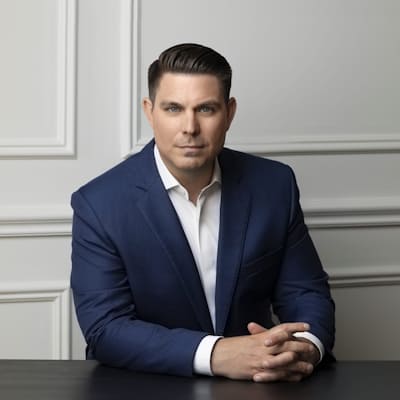
Ronald Chapman II is the founder of Chapman, Dowling & Mallek and a top-rated Michigan federal criminal defense attorney who represents clients in federal courts nationwide. His practice is focused on defending individuals and organizations in complex federal prosecutions, including white-collar criminal matters and healthcare fraud investigations.
Throughout his career, Mr. Chapman has helped clients avoid more than $550 million in potential penalties, primarily in cases involving physicians, healthcare providers, executives, and professionals facing federal charges. He is widely recognized for his work as a Michigan healthcare fraud defense attorney, as well as for his results in white collar criminal defense in Michigan, where cases often involve parallel civil, regulatory, and criminal exposure.
Apr-8-2026
Hospice fraud is a serious enforcement priority for Medicare, and federal regulators are under pressure...
Apr-2-2026
In federal court, some of the most important battles happen after trial—on appeal—where the focus...
Jan-9-2026
Memphis, Tennessee – The verdict returned this week in United States v. Sanjeev Kumar closed...
Dec-31-2025
Dr. Lonnie Joseph Parker, a Texarkana physician, was recently convicted in federal court of unlawfully...
Serving Clients Nationwide.
Chapman, Dowling & Mallek is headquartered in Detroit, Michigan and represents clients in federal investigations and criminal matters across the United States. Our attorneys handle complex federal cases nationwide while maintaining offices in Michigan and other states.
456 E. Milwaukee, Detroit, MI 48202
2 Comments
Looking forward to the outcome of this case once the Supreme Court weighs in… Keep Fighting!!
Ronald Chapman II and Matthew Murray are the best legal defense a physician could hope for! They have our support and prayers while defending Dr. Anderson's rights and those of many other innocent doctors. The system is stacked against the innocent and since the Supreme Court's Ruan ruling, those who have been wrongfully accused and imprisoned, now have a chance to be exonerated and free from malicious prosecutions.