
Litigator in Chief: Trump’s Early Term Court Battles
Insights from White Collar Criminal Defense Attorneys Trusted Nationwide
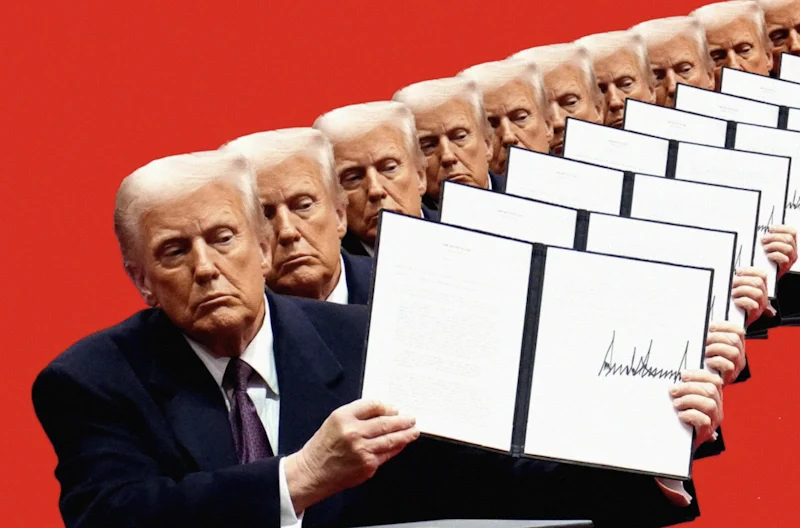
President Donald Trump’s broad array of executive actions since his reelection has generated a sizeable docket of federal litigation—at least 45 lawsuits spanning questions of immigration, federal spending, LGBTQ+ rights, and beyond. While these lawsuits underscore the vigilance of the American system of checks and balances, they also highlight a potential constitutional crisis should higher courts or the executive branch refuse to align with each other. This article evaluates the legal arguments, procedural complexities, and potential trajectories of these challenges from a constitutional lawyer’s standpoint.
Federal Spending and “Impoundment”: Plaintiffs claim the president is illegally withholding or redirecting appropriated funds, echoing historical battles (e.g., Nixon-era impoundment disputes).
Civil Service Restructuring: Measures to shrink the federal workforce or reconfigure agencies, like the Department of Government Efficiency (DOGE), face challenges under federal transparency and statutory authorization requirements.
Transgender and LGBTQ+ Policies: Advocacy groups question the constitutionality of executive orders that rescind certain protections or benefits, citing Due Process and Equal Protection Clause arguments.
Temporary Restraining Orders (TROs) have swiftly blocked several actions—from the birthright citizenship order to cuts in various agencies. However, TROs are ephemeral, often expiring in days or weeks.
Preliminary Injunctions: Some judges have issued longer-lasting blocks, but these too are subject to appeal and potential reversal by more conservative appellate panels or the Supreme Court.
Standing and Venue Selection
Plaintiff “Shopping”: Litigants often strategically file in jurisdictions more receptive to their legal arguments—Republicans might choose the Fifth Circuit states (Texas, Louisiana, Mississippi), while Democrats lean toward circuits like the First or Fourth.
Justiciability Hurdles: Plaintiffs must show standing, a particularized injury, and a clear legal basis to ensure the suit is heard on its merits.
Three-Tiered Federal Judiciary and Appeal Pathways
District Courts: One judge’s immediate ruling can block or delay an executive action. Yet preliminary injunctions are only a first step—once appealed, the matter ascends to a three-judge appellate panel, which might be less ideologically sympathetic to the plaintiffs.
Courts of Appeals: Ideological composition is critical. An initially “friendly” trial court decision may be reversed by conservative appellate panels.
Supreme Court: Ultimately, the highest court has wide discretion over its docket. It can stay lower-court orders via the “shadow docket” even before it decides whether to grant full review.
Executive Compliance
Historically, presidents have eventually complied with definitive court orders. However, skepticism persists regarding whether Trump might emulate President Andrew Jackson’s infamous disregard for judicial authority.
Given the Supreme Court’s conservative tilt—and its occasional willingness to allow expansive presidential power—there is no certainty that these lawsuits will permanently stymie Trump’s agenda.
Separation of Powers and Non-Delegation
By attempting to “impound” duly appropriated funds, the president could be violating the constitutional allocation of the spending power to Congress.
If upheld, some of these executive actions could effectively grant the presidency a level of unilateral budgetary control not seen since before the Congressional Budget and Impoundment Control Act of 1974.
The Fourteenth Amendment and Birthright Citizenship
Textually, birthright citizenship is firmly embedded in the 14th Amendment’s Citizenship Clause. Courts are unlikely to uphold an executive order that effectively rewrites that clause—at least if they adhere to stare decisis as developed since United States v. Wong Kim Ark (1898).
Administrative Law Constraints
Laws like the Federal Advisory Committee Act (FACA) and the Administrative Procedure Act (APA) impose procedures on newly formed agencies like DOGE. Plaintiffs argue that ignoring these statutes leads to “arbitrary and capricious” executive actions.
Equal Protection and Civil Rights
Transgender rights lawsuits revolve around discrimination claims. Should the Supreme Court recognize heightened scrutiny for transgender-based discrimination, executive orders contravening such rights face an uphill battle.
These lawsuits collectively raise fundamental questions about the scope of executive power, the extent of congressional authority, and the judiciary’s willingness to enforce constitutional limits. While the early successes for plaintiffs demonstrate a judiciary still capable of checking executive overreach, the fate of these challenges in higher courts is less certain.
Where Do We Go from Here
A surge of appeals will hit the circuit courts in the coming months and years. The shift from “friendly” trial judges to random appellate panels could reshape outcomes.
The Supreme Court’s conservative majority has signaled a relatively permissive view of executive power in various contexts, including decisions on immigration and national security.
If the president defies judicial orders or the courts rubber-stamp suspect actions, the constitutional equilibrium could be profoundly tested.
The current wave of litigation against President Trump underscores the intricate balance of powers at the heart of the Constitution. Whether these lawsuits mark the beginning of a robust check on executive action or a fleeting respite amid judicial deference remains to be seen. Constitutional lawyers and scholars will watch closely as appellate courts—and ultimately the Supreme Court—clarify the limits of presidential authority in this pivotal juncture of American governance.
Ronald Chapman II is the founder of Chapman, Dowling & Mallek and a top-rated Michigan federal criminal defense attorney who represents clients in federal courts nationwide. His practice is focused on defending individuals and organizations in complex federal prosecutions, including white-collar criminal matters and healthcare fraud investigations.
Throughout his career, Mr. Chapman has helped clients avoid more than $550 million in potential penalties, primarily in cases involving physicians, healthcare providers, executives, and professionals facing federal charges. He is widely recognized for his work as a Michigan healthcare fraud defense attorney, as well as for his results in white collar criminal defense in Michigan, where cases often involve parallel civil, regulatory, and criminal exposure.


Apr-8-2026
Hospice fraud is a serious enforcement priority for Medicare, and federal regulators are under pressure...
Apr-2-2026
In federal court, some of the most important battles happen after trial—on appeal—where the focus...
Jan-9-2026
Memphis, Tennessee – The verdict returned this week in United States v. Sanjeev Kumar closed...
Dec-31-2025
Dr. Lonnie Joseph Parker, a Texarkana physician, was recently convicted in federal court of unlawfully...
Serving Clients Nationwide.
Chapman, Dowling & Mallek is headquartered in Detroit, Michigan and represents clients in federal investigations and criminal matters across the United States. Our attorneys handle complex federal cases nationwide while maintaining offices in Michigan and other states.
456 E. Milwaukee, Detroit, MI 48202