Trump’s 11th Amendment Brief: Rooted in History or Wishful Thinking?
Insights from White Collar Criminal Defense Attorneys Trusted Nationwide
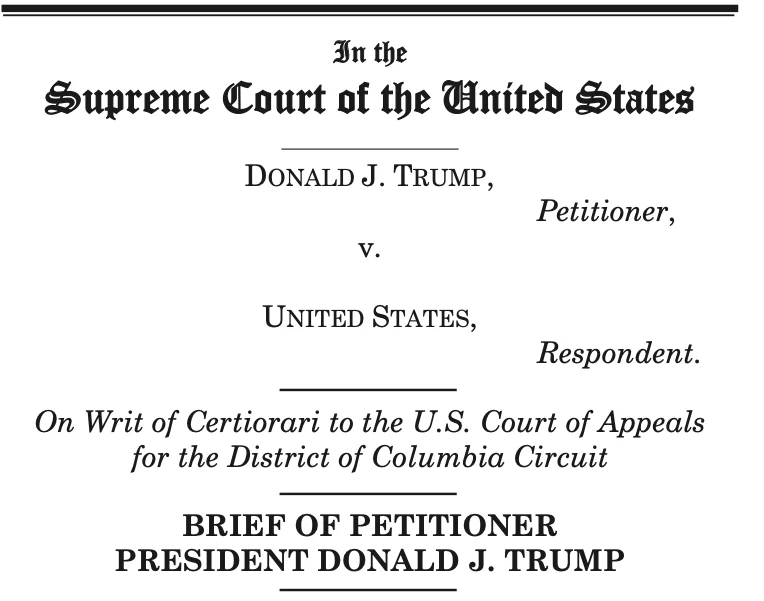
Is it rooted in history? Or wishful thinking?
Trump draws on a long line of precedent, and the President is batting .1000 on non-prosecution. This is despite Watergate, Monica Lewinsky, WMD, and even a duel or two. While we wait for a rebuttal, Trump’s arguments are deeply rooted, even in the first case, which reached the Supreme Court in 1803. Since then, the President has had an unbroken string of wins and has survived some salacious scandals and outright criminal activity.
Let’s take a look at the arguments.
Trump’s stance is not a new development. It has a deep-rooted history in the annals of U.S. legal history and dates back to landmark cases such as Fitzgerald v. Nixon and Barr v. Matteo. These precedents highlight a fundamental principle, which is the President’s absolute immunity from civil damages liability for acts within the “outer perimeter” of their official responsibilities. This doctrine is not a free pass, but rather a recognition of the unique role and responsibilities of the presidency. It is designed to ensure that the fear of litigation does not disrupt decision-making.
This principle was echoed in Marbury v. Madison, a cornerstone of American constitutional law, where the idea that the President’s responsibility is primarily to his country and conscience was first articulated. Such immunity is seen not as a shield for wrongdoing but as a necessary bulwark against the encroachments that could undermine the executive branch’s functioning.
Trump’s counsel draw’s from a rich tapestry of cases historically reinforcing the judiciary’s reluctance to intervene in presidential duties. From Martin v. Mott, where the Supreme Court declined jurisdiction over President Madison’s actions during the War of 1812, to Mississippi v. Johnson, which barred judicial injunctions against President Johnson’s enforcement of the Reconstruction Acts, the message has been consistent: impeachment, not judicial review, is the prescribed remedy for presidential missteps.
This doctrine of non-intervention is premised on a profound respect for the separation of powers. It recognizes that certain decisions, imbued with political judgment, are beyond the courts’ competence to adjudicate.
The specter of criminal prosecution or civil liability for actions taken in the office could significantly impair the presidency’s efficacy. The brief highlights a litany of instances where presidents, from John Quincy Adams to Barack Obama, have been accused of criminal acts by political adversaries. Yet, history shows us that prosecution of these leaders, absent impeachment and conviction by Congress, remains an uncharted and potentially dangerous path.
This argument concerns protecting individual incumbents and safeguarding the presidency itself. It posits that without such immunity, every presidential decision could be second-guessed through litigation, chilling executive initiative, and distorting the constitutional allocation of powers.
Trump’s brief meticulously argues that his January 6th actions fall squarely within the ambit of presidential duties and merit absolute immunity. This claim concerns not just the events of that day but underscores a broader principle that presidential communications, decisions, and even missteps, when made within the scope of official duties, should not be subject to judicial review.
The argument extends beyond just claiming immunity; it seeks a judicial affirmation that would solidify the scope of executive actions considered immune. This includes various activities, from communications with the Department of Justice to federal policy and personnel decisions. By framing these actions within the context of his presidential role, Trump’s argument serves as a litmus test for the breadth of presidential immunity which he argues is broad.
The fundamental question remains: where should the line be drawn between ensuring the president effectively discharges his duties and holding him accountable for actions that overstep legal and constitutional bounds?
At the heart of the doctrine of presidential immunity, this balancing act underscores the delicate interplay between safeguarding the executive’s independence and upholding the rule of law in a constitutional democracy.
Jack Smith will argue that he gets to decide or that an American jury of 12 gets to decide. His arguments will not prevail, presidential immunity for official acts will prevail and preserve our democracy for future generations.
Ronald Chapman II is the founder of Chapman, Dowling & Mallek and a top-rated Michigan federal criminal defense attorney who represents clients in federal courts nationwide. His practice is focused on defending individuals and organizations in complex federal prosecutions, including white-collar criminal matters and healthcare fraud investigations.
Throughout his career, Mr. Chapman has helped clients avoid more than $550 million in potential penalties, primarily in cases involving physicians, healthcare providers, executives, and professionals facing federal charges. He is widely recognized for his work as a Michigan healthcare fraud defense attorney, as well as for his results in white collar criminal defense in Michigan, where cases often involve parallel civil, regulatory, and criminal exposure.

Apr-8-2026
Hospice fraud is a serious enforcement priority for Medicare, and federal regulators are under pressure...
Apr-2-2026
In federal court, some of the most important battles happen after trial—on appeal—where the focus...
Jan-9-2026
Memphis, Tennessee – The verdict returned this week in United States v. Sanjeev Kumar closed...
Dec-31-2025
Dr. Lonnie Joseph Parker, a Texarkana physician, was recently convicted in federal court of unlawfully...
Serving Clients Nationwide.
Chapman, Dowling & Mallek is headquartered in Detroit, Michigan and represents clients in federal investigations and criminal matters across the United States. Our attorneys handle complex federal cases nationwide while maintaining offices in Michigan and other states.
456 E. Milwaukee, Detroit, MI 48202