
Hedge Fund Trader Shorts SEC: SEC v. Jarkesy
Insights from White Collar Criminal Defense Attorneys Trusted Nationwide
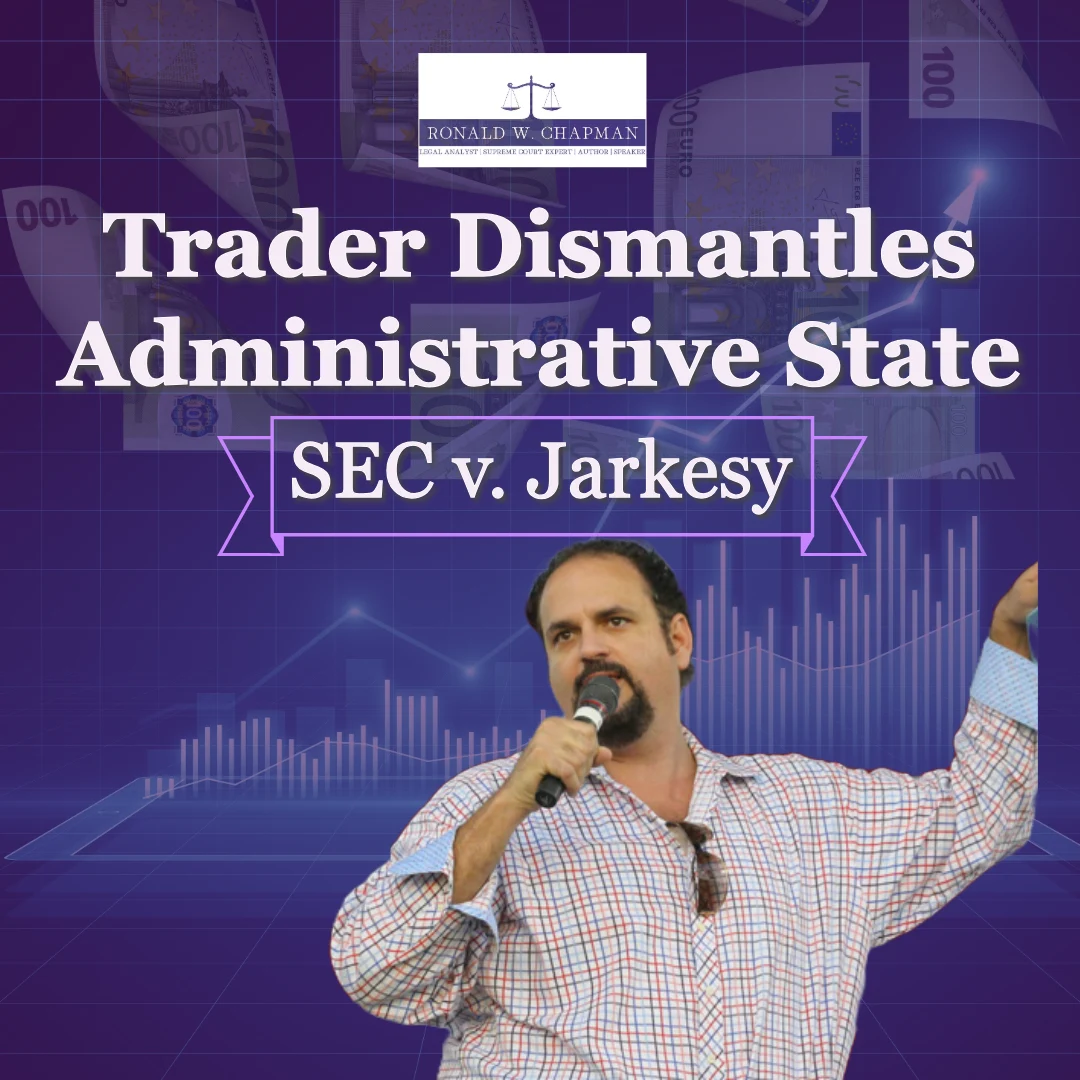
“You get a jury trial, and you get a jury trial”…the SEC is going to have to sound a lot more like Oprah around Christmas as a result of a recent SCOTUS decision. This is a case that will impact all of us and it's likely the bell lap in the race to reduce administrative power.
In short, the ability to strip traders of assets without a jury trial has evaporated. And this case will extend much further than the SEC.
SCOTUS delivered a significant blow to the expansive powers of the administrative state in the case of SEC v. Jarkesy. This case centered on whether the Securities and Exchange Commission (SEC) could unilaterally adjudicate fraud claims and impose civil penalties through its in-house administrative process without infringing on the Seventh Amendment right to a jury trial.
The case originated when the SEC pursued enforcement action against George Jarkesy and his firm, Patriot28, for alleged securities fraud. Opting to handle the matter internally, the SEC bypassed the traditional judicial system, a move that Jarkesy contested as a violation of his constitutional rights. This decision by the SEC to adjudicate in-house was enabled by the Dodd-Frank Wall Street Reform and Consumer Protection Act, which extended the agency’s power to impose civil penalties without resorting to federal court.
The Supreme Court’s decision is steeped in historical and legal precedent, underscoring the fundamental importance of the right to a jury trial. Chief Justice Roberts, writing for the majority, emphasized the deeply rooted significance of this right in both English and American legal traditions. He highlighted, “The right to trial by jury is ‘of such importance and occupies so firm a place in our history and jurisprudence that any seeming curtailment of the right’ has always been and ‘should be scrutinized with the utmost care.’” (Dimick v. Schiedt, 293 U. S. 474, 486).
The Court drew parallels between the SEC’s pursuit of civil penalties and traditional common law fraud. Both target the same fundamental behavior: misrepresenting or concealing material facts. By framing its anti-fraud provisions in terms familiar to common law, Congress had effectively enshrined these protections within the realm of traditional legal claims, which necessitate a jury trial.
In a decisive opinion, the Court held that when the SEC seeks civil penalties for securities fraud, the Seventh Amendment guarantees the defendant the right to a jury trial. The ruling reaffirmed that traditional legal claims, especially those seeking punitive remedies, must be adjudicated in a court of law where a jury can scrutinize the evidence and render a verdict.
Chief Justice Roberts clarified the nature of the civil penalties sought by the SEC, stating, “Civil penalties are a type of remedy at common law that could only be enforced in courts of law.” (Tull, 481 U. S., at 422). The Court dismantled the SEC’s argument that the public rights exception applied. This exception, allowing Congress to assign certain matters to administrative agencies, does not extend to claims that fundamentally require punitive remedies and are akin to common lawsuits. As Roberts noted, “Congress cannot ‘conjure away the Seventh Amendment by mandating that traditional legal claims be … taken to an administrative tribunal.’” (Granfinanciera, 492 U. S., at 52).
The Court also touched on two additional constitutional issues raised by Jarkesy and Patriot28:
1. Non-Delegation Doctrine: The Court considered whether Congress had violated the non-delegation doctrine by granting the SEC unchecked authority to choose between federal court and in-house adjudication. While the Court did not reach a definitive conclusion on this issue, the primary Seventh Amendment issue was deemed dispositive.
2. For-Cause Removal Protections: The Court examined the constitutionality of the SEC’s administrative law judges (ALJs) having two layers of for-cause removal protections, which could potentially violate the separation of powers principle. Similar to the non-delegation doctrine issue, the Court did not render a final decision on this matter, as resolving the jury trial issue was sufficient to decide the case.
Justice Sotomayor, joined by Justices Kagan and Jackson, dissented. They argued that the public rights exception should apply due to the regulatory nature of the SEC’s enforcement action, emphasizing the government’s interest in efficiently enforcing securities laws. However, the majority’s robust defense of constitutional protections carried the day.
This ruling significantly curtails the SEC’s ability to impose penalties through its administrative process, marking a shift towards greater judicial oversight and accountability. The decision is expected to prompt other regulatory agencies to reconsider their enforcement tactics, potentially increasing the caseload of federal courts and ensuring that defendants’ rights to a jury trial are upheld.
The decision is a clear victory for those who advocate for rolling back the administrative state. It reinforces the judiciary’s role in upholding constitutional rights and limiting the overreach of administrative agencies. This ruling could inspire broader challenges against administrative adjudications, setting a precedent for a future where the balance of power is more firmly rooted in the judiciary.
Ronald Chapman II is the founder of Chapman, Dowling & Mallek and a top-rated Michigan federal criminal defense attorney who represents clients in federal courts nationwide. His practice is focused on defending individuals and organizations in complex federal prosecutions, including white-collar criminal matters and healthcare fraud investigations.
Throughout his career, Mr. Chapman has helped clients avoid more than $550 million in potential penalties, primarily in cases involving physicians, healthcare providers, executives, and professionals facing federal charges. He is widely recognized for his work as a Michigan healthcare fraud defense attorney, as well as for his results in white collar criminal defense in Michigan, where cases often involve parallel civil, regulatory, and criminal exposure.


Apr-8-2026
Hospice fraud is a serious enforcement priority for Medicare, and federal regulators are under pressure...
Apr-2-2026
In federal court, some of the most important battles happen after trial—on appeal—where the focus...

Jan-9-2026
Memphis, Tennessee – The verdict returned this week in United States v. Sanjeev Kumar closed...
Dec-31-2025
Dr. Lonnie Joseph Parker, a Texarkana physician, was recently convicted in federal court of unlawfully...
Serving Clients Nationwide.
Chapman, Dowling & Mallek is headquartered in Detroit, Michigan and represents clients in federal investigations and criminal matters across the United States. Our attorneys handle complex federal cases nationwide while maintaining offices in Michigan and other states.
456 E. Milwaukee, Detroit, MI 48202