
Fred Korematsu and Japanese Internment
Insights from White Collar Criminal Defense Attorneys Trusted Nationwide

Of the 120,000 Japanese Americans subject to relocation, exclusion and internment during World War II only 12 resisted. Fred Korematsu was one of them.
Those who willingly complied with the military order to leave their homes, businesses, and way of life complied not because of “patriotism” but fear. Anti-Japanese sentiment in the aftermath of the bombing of Pearl Harbor was high and Japanese Americans were subject to frequent abuses, discrimination, and hatred. On December 7, 1941, the United States entered World War II and at that time nearly 113,000 people of Japanese ancestry were located in California, Washington and Oregon. Fearing an imminent attack on the west coast of the United States, President Franklin D. Roosevelt signed Executive Order No. 9066 which permitted the United States Army to create military exclusion zones. Here is the story of how mass hysteria lead to the warrantless and baseless arrests of an entire population and was challenged by one man Fred Korematsu.
“The Japanese race is an enemy race. The very fact that no sabotage has taken place to date is a disturbing and confirming indication that such action will be taken”
Anti-Japanese hysteria in the United States was rampant even before the attack on Pearl Harbor. But after the attack, the 1940’s press was just as prone to clickbait as their modern successors and blasted out headlines warning of an imminent attack on United States Soil and “spies among us”. The press fueled by the Department of Justice lead the people to believe that there was a large underground network of spies located in the west coast, all of whom were of Japanese descent. Americans became concerned that this mass network of spies was capable of causing sabotages that would disable west coast defenses and leave the mainland vulnerable to a Japanese invasion.
This fear of subversive activity became known as “the fifth column” – a phrase that is given to residents of a nation assisting a foreign attacking force. The phrase is a translation of the Spanish Quinta Columna which was inspired by rebel general Emilio Mola during the Spanish Civil War who predicted that Madrid would fall as four columns of rebel troops descending on the city were joined by another hidden column of sympathizers within it. The phrase gained widespread popularity after Ernest Hemingway used it in the title of his 1938 book.
In a shameless dog whistle to the anti-Japanese sentiment that was brewing in the United States, Frank Knox, Roosevelt’s Secretary of the Navy, blamed Pearl Harbor on “the most effective fifth column work that’s come out of this war, except in Norway.” His attempt at blaming Pearl Harbor on subversive Japanese Americans was a clear effort to turn attention away from the United States' significant intelligence failures that lead to the attack on Pearl Harbor.
There was no Fifth Column, no subversive activity, no massive underground network of spies – only an effort by the American Government to mask its own failures with American propensity for xenophobia.
And so, supported by an angered public falsely blaming Japanese Americans for the attack on Pearl Harbor, instead of looking inward to their own government – the groundwork was laid for Japanese internment. Surely anyone speaking out against internment would be cloaked in the stench of supporting Anti-American activity and even those with serious moral misgivings about what was to come would look the other way for fear of being ostracized or attacked by their own government as sympathizers.
The first step towards Japanese internment was the mass arrest of Japanese American citizens suspected of being Japanese sympathizers. Department of Justice organized the arrests of 3,000 people that it considered “dangerous” enemy aliens, most were Japanese. Some were community leaders who were involved in Japanese organizations and religious groups. None of the arrests were supported by probable cause or warrants. At the same time bank accounts of all “enemy aliens” and all accounts in American branches of Japanese banks were frozen. This forced many Japanese American citizens who chose to do business with Japanese banks into bankruptcy. Businesses shuttered, families starved and their will was broken.
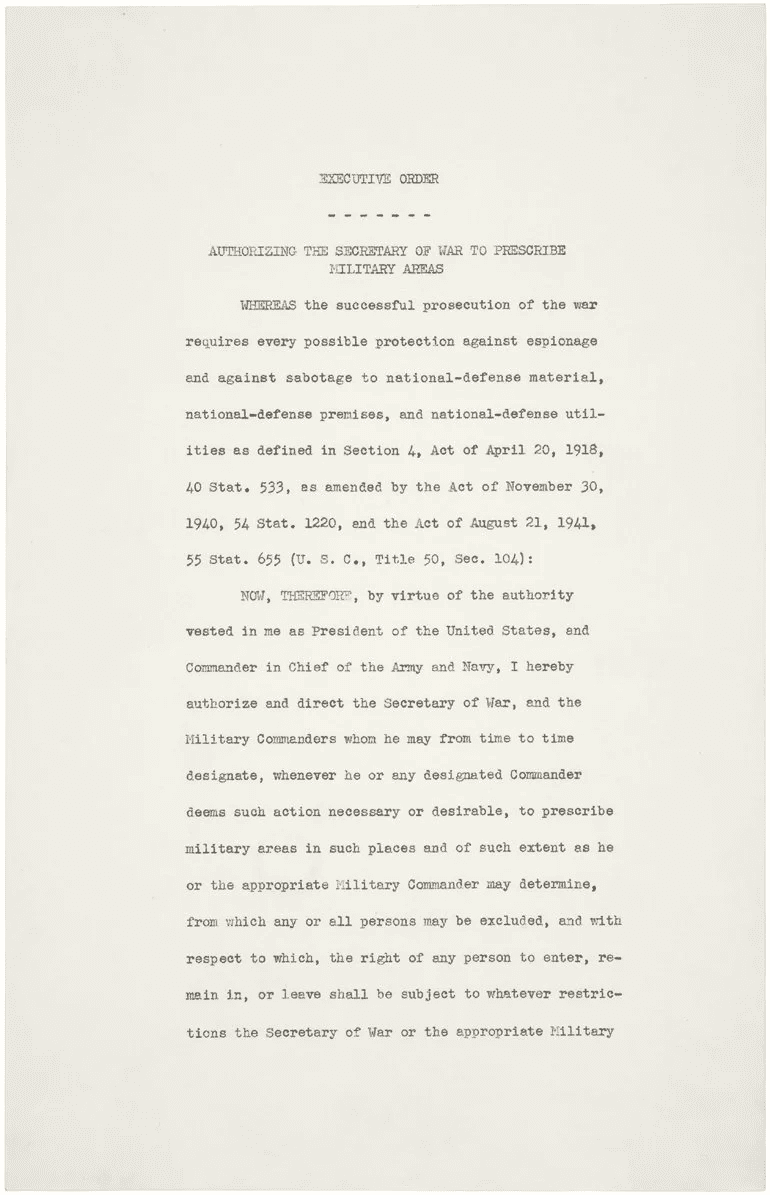
President Roosevelt quickly passed Executive order No. 9066.
The executive order gave broad authority to military commanders to determine which areas require exclusion and provided absolutely no restraint on the size of the zones and who must be excluded. Following the executive order Lieutenant General John L. DeWitt, commander of the U.S. Army Western Defense Command, and in control of the western United States, established a large exclusion zone along the west coast and demanded that all Japanese Americans, including both citizens and non-citizens report to civilian assembly centers. His rationale was that Japanese citizens could signal with lights and make radio transmissions that would aid in a Japanese attack. None of these claims have been since verified.
General DeWitt submitted his recommendations orders to the president which called for the removal of all Japanese Americans and descendants of Japanese Americans from an entire area lying west of the Sierra Nevada and Cascade Mountains. He justified this action on the basis of “military necessity” stating “the Japanese race is an enemy race” and “the very fact that no sabotage has taken place to date is a disturbing and confirming indication that such action will be taken”. As if lack of evidence is evidence of an impending invasion. On a moments notice, thousands of Japanese Americans, who established a peaceful life in the western United States, were forced to close their businesses, abandon homes, and farms and move into internment camps which were conveniently called “relocation centers”. Some detainees were sent back to Japan and others were moved to the eastern United States and outside the exclusion zones.
In mid-February California congressman John Tolan headed congressional hearings to address the need for evacuation of Japanese Americans. The overwhelming majority of witnesses and congressmen supported the removal of all Japanese from coastal areas. And congress would later sign an act codifying the executive order and making it United States law. Public Law No. 503 made violating restrictions in a military area a misdemeanor and punishable by a $5,000 fine and a year in jail.
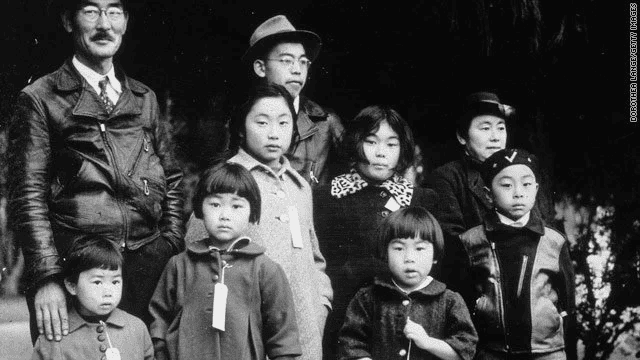
Pursuant to the evacuation orders evacuations began quickly leaving Japanese Americans only six days to relocate. By June 2, 1942, all Japanese in Military Area No. 1 were in army custody. Almost no one resisted – except Fred Korematsu.
On Memorial Day 1942, Fred Korematsu was walking down the street in San Leandro California with his girlfriend when he was arrested “on suspicion of being Japanese”. Fred thought he wouldn’t get caught, the 23-year-old welder born in Oakland California to Japanese immigrant parents had surgery to change his appearance and changed his name to protect his Japanese identity. Clyde Sarah was the name he provided the San Leandro police – he said that his parents were of Spanish and Hawaiian ancestry. But his draft card looked altered, which alerted police to his real identity. Eventually, under the pressure of police interrogation he broke down and confessed. The news widely reported Korematsu’s arrest and the fact that he altered his appearance again to boost anti-Japanese propaganda.
Thankfully, there are citizens who have the willingness to fight oppression and organizations willing to help them in their journey.
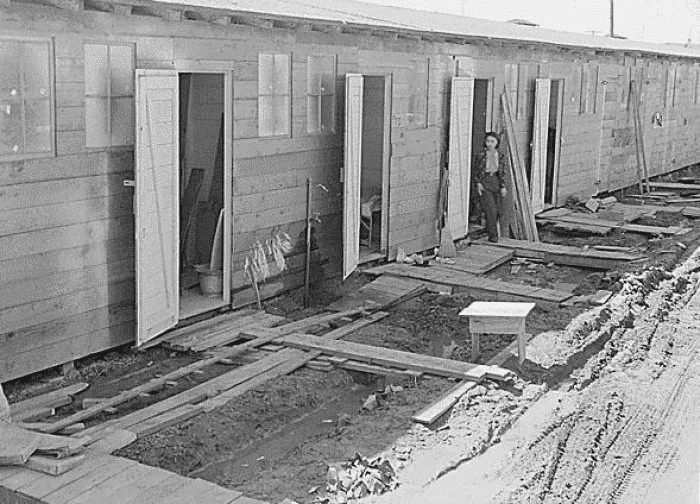
But for the American Civil Liberties Union – this would be the last interesting fact in the Korematsu story. Under the threat of incarceration he would have plead guilty to the charge of evading detention and would never have challenged the internment order. Though the ACLU approached several resisters Korematsu was different. He had a passion for the belief in liberty and American ideals he learned in school and was more motivated than most to fight the charges. He was approached in custody by the ACLU while detained at the Tanforan Assembly Center. The “relocation center” was a former racetrack where he was forced to live in a horse stall with a cot, straw mattress and one lightbulb. His conditions of confinement in “relocation” were much worse than in jail.
Ronald Chapman II is the founder of Chapman, Dowling & Mallek and a top-rated Michigan federal criminal defense attorney who represents clients in federal courts nationwide. His practice is focused on defending individuals and organizations in complex federal prosecutions, including white-collar criminal matters and healthcare fraud investigations.
Throughout his career, Mr. Chapman has helped clients avoid more than $550 million in potential penalties, primarily in cases involving physicians, healthcare providers, executives, and professionals facing federal charges. He is widely recognized for his work as a Michigan healthcare fraud defense attorney, as well as for his results in white collar criminal defense in Michigan, where cases often involve parallel civil, regulatory, and criminal exposure.
Apr-8-2026
Hospice fraud is a serious enforcement priority for Medicare, and federal regulators are under pressure...
Apr-2-2026
In federal court, some of the most important battles happen after trial—on appeal—where the focus...
Jan-9-2026
Memphis, Tennessee – The verdict returned this week in United States v. Sanjeev Kumar closed...
Dec-31-2025
Dr. Lonnie Joseph Parker, a Texarkana physician, was recently convicted in federal court of unlawfully...
Serving Clients Nationwide.
Chapman, Dowling & Mallek is headquartered in Detroit, Michigan and represents clients in federal investigations and criminal matters across the United States. Our attorneys handle complex federal cases nationwide while maintaining offices in Michigan and other states.
456 E. Milwaukee, Detroit, MI 48202