
PAPERS PLEASE: DOD EXPANDS THE USE OF DEADLY FORCE AGAINST CIVILIANS
Insights from White Collar Criminal Defense Attorneys Trusted Nationwide

Ron Chapman is a former Marine Corps judge Advocate and has significant experience training United States Marines on use-of-force guidelines, including DOD 5240.1
When most people think about military power in America, they think about foreign threats—the military as a shield against forces outside our borders. But what happens when that military power starts turning inward? We’ve got laws for that: the Posse Comitatus Act, a piece of legislation from 1878, specifically limits the federal government’s ability to use the armed forces for domestic law enforcement. It’s a cornerstone of American democracy, a way to ensure that our government doesn’t blur the line between military and police—a line that keeps us from becoming a country where soldiers patrol our streets.
That line was blurred by these three changes to the DOD Directive for the Use of Force:

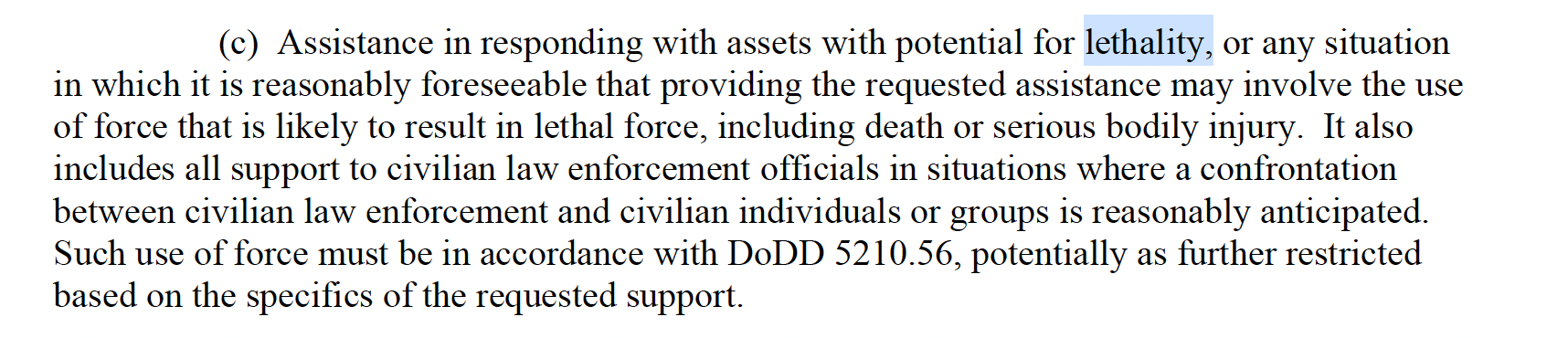

The DoD’s recent Directive 5240.01, though, feels like a quiet step in the opposite direction. It essentially broadens the military’s authority to aid law enforcement during “civil disturbances.” Now, let’s unpack what that means and why it matters. The Directive authorizes support in “exigent circumstances,” like natural disasters or large-scale violence.
Take, for example, the events of January 6th, a day that will likely live in our memories—and the history books—for a long time. It’s not hard to imagine how a future administration might use this Directive to call in the troops if something like that were to happen again. Under the current directive, we’re looking at a situation where, if civil disorder escalates, the Secretary of Defense could approve the use of military assets in the streets. And if the situation calls for it, there’s even potential for deadly force.
The door is open for them to act swiftly, especially if there’s a perceived threat to life. It’s a fast-track process designed to give the military flexibility in chaotic situations, but at what cost? This could place the military in direct confrontation with civilians on U.S. soil.
Out Now on Amazon!
Then we have the September 27th update, which feels like a preparation for something bigger. Why would the DoD suddenly need clearer guidelines on using force, particularly in response to civil unrest? Are they expecting something? Preparing for the unthinkable—like a coup or large-scale insurrection? This update suggests a shift towards readiness, a proactive stance, where military intervention could very well become a tool in maintaining “order.” And that sounds a lot like the prelude to government overreach.
It’s not just about enforcing the law; it’s about setting up a system that can quickly transition to military action. We’re not talking about disaster relief or a one-off situation. This Directive reads like a playbook for long-term domestic military engagement. So as we consider the implications of Directive 5240.01, we should remember that laws are only as good as the people enforcing them—and the power they’re given. If we start seeing the military on U.S. soil, positioned to “restore order” or confront “civil disturbances,” we might want to ask: Where does it end? And at what point do we stop being civilians in a democracy and start becoming citizens in a security state?
When we talk about using the military for domestic issues, we’re talking about a serious step—one that often comes with unintended consequences. The term “civil disturbance” sounds tame, almost clinical, but its history in America is anything but. And when military force has been used to manage these situations, it hasn’t always gone well.
Consider Kent State University in 1970. It was a time of heavy anti-war protests across the country, with young people taking to the streets to challenge U.S. involvement in Vietnam. On May 4, Ohio National Guard troops were called in to quell a protest. There was no real plan—just a directive to maintain order. But somewhere in that chaotic mix of protestors, tear gas, and confusion, guardsmen fired on the unarmed students. Four young Americans were killed, nine others wounded, in a tragic escalation of force. This wasn’t an attack on the enemy—it was an attack on American citizens exercising their rights. Kent State became a symbol of what can go wrong when the military’s tools are used in civilian settings, a haunting reminder that lethal force should be the very last resort.
This wasn’t the first, and certainly not the last, time force was used in response to civil unrest. Take the 1967 Detroit riots, part of what came to be known as the “Long, Hot Summer” of riots in over 150 American cities. When state and federal troops were deployed, Detroit looked more like a war zone than an American city. Buildings burned, tanks rolled down streets, and there were 43 deaths, many of them civilians caught in the crossfire. These were citizens who, while reacting to systemic inequalities, found themselves under military control in their own neighborhoods.
Even more recently, the Los Angeles riots in 1992 following the acquittal of officers in the Rodney King beating showed how quickly a situation could escalate. The National Guard was called in, followed by the Army and Marine Corps, and Los Angeles erupted in flames. The images of armed soldiers and military vehicles on city streets highlighted how civilian protests can feel like enemy territory when the military steps in. While these forces helped restore order, the aftermath left communities deeply scarred, both physically and emotionally.
These historical moments highlight the risks we face today. Under DoD Directive 5240.01, the door is open for similar deployments if a future civil disturbance meets certain criteria. And when we examine the August 27th update, we see an undeniable readiness for large-scale unrest. The military is authorized to assist in “civil disturbances” where there’s a perceived threat to public safety. But as we’ve learned from history, public safety is sometimes a subjective term, especially in the hands of those tasked with enforcing it.
Take January 6th as a modern example. Imagine if the DoD Directive had been in play then, with a broader authorization to use military force. Would there have been armed troops on Capitol grounds, ready to face off with American citizens? In hindsight, it’s easy to see how quickly a civil disturbance could transform into a battleground, especially with directives like this one, giving the military significant latitude in deciding what constitutes an appropriate response.
These aren’t abstract scenarios. They’re reminders of what can happen when force is used to confront civilian unrest. And each of these events raises a troubling question: If the military is increasingly ready to step in, at what point do our streets become part of a military jurisdiction? At what point does “keeping order” cross over into suppressing dissent?
History teaches us that force—especially military force—can amplify chaos rather than control it. When DoD Directive 5240.01 signals a willingness to consider military intervention, it’s more than just a policy update. It’s a shift in how the government might approach domestic challenges in the future. We’ve seen where this path leads before, and the results are often irreversible. As we grapple with this new directive, we should keep these historical lessons in mind and ask ourselves if this is a road we’re willing to go down again.
Let’s walk through a hypothetical scenario where, under the modification of DoD Directive 5240.01, the military could be deployed in response to election-related unrest. Here’s how it could play out under the current provisions:
Imagine an election in which the results are highly contested. Protests erupt in multiple cities, and tensions are high. The protests escalate into violent clashes, with property damage and significant threats to public safety. Local law enforcement is unable to contain the situation, and state resources are stretched thin. This level of unrest could meet the definition of a “civil disturbance,” which DoD Directive 5240.01 now addresses directly.
In this scenario, the governor of the state could request federal assistance if they feel local and state resources are inadequate. Alternatively, federal authorities, such as the Department of Justice, might assess that the unrest poses a significant threat to national security or other critical infrastructure and could request military intervention to support law enforcement.
According to DoD Directive 5240.01, the Secretary of Defense holds the authority to approve requests for military assistance to address civil disturbances. Here’s the process:
Secretary of Defense Approval: For scenarios that may involve lethal force or where significant military resources are required, the Secretary of Defense must personally authorize the deployment.
Considerations: The Secretary, before making a decision, would review factors such as lethality, risk, cost, appropriateness, readiness, and scope. The legal office for the DoD would need to confirm that deploying the military is lawful under these circumstances.
Immediate Authorization for Exigent Circumstances: If time is a factor, and the Secretary or Under Secretary of Defense for Intelligence and Security (USD(I&S)) cannot approve in time, the head of a Defense Intelligence Component could authorize deployment. They must report this action to the Secretary or USD(I&S) within 72 hours and gain approval to continue if necessary.
Once approved, the deployment would involve detailed coordination with local law enforcement and federal agencies like the FBI, which could work with military intelligence units. These units may provide surveillance, intelligence, and logistical support to local law enforcement, and, if authorized, military personnel might actively participate in crowd control operations or secure key infrastructure.
Rules of Engagement: The Directive requires that any military personnel deployed in such a scenario must adhere to specific rules of engagement (ROE), which would define when and how force, including deadly force, can be used. In this scenario, military personnel could be instructed to use force only in situations where there is a direct threat to life or serious injury.
If the situation intensifies—say, protests turn into riots, and rioters threaten critical infrastructure or government officials—the military may be authorized to use force, including potentially lethal force. The Directive authorizes the Secretary of Defense to allow the use of lethal force if “reasonably foreseeable” that a confrontation could result in serious injury or death. This could mean:
Lethal Force Authorization: Military personnel on the ground, likely under the command of the National Guard or another military branch, would have authorization for lethal force but would follow strict ROE to minimize unnecessary harm. If any individual poses a direct threat to military personnel, law enforcement, or critical assets, lethal force could be used.
Throughout this process, the DoD’s General Counsel and legal advisors would work closely with the operational command to ensure that all activities comply with the Posse Comitatus Act. However, the Directive’s language provides a legal framework that potentially expands the military’s role in such domestic matters, giving room for direct engagement under specified circumstances.
The Directive, particularly with the August 27th update, appears tailored to allow faster, more streamlined military response to domestic disturbances. In an election-related disturbance, this means the federal government could quickly deploy the military to support local law enforcement without extensive bureaucratic delay. The updated Directive reflects a readiness to address large-scale unrest that could threaten government stability, a move that, some might argue, prepares the government for worst-case scenarios such as a coup attempt or large-scale insurrection.
In short, this Directive facilitates a more agile deployment of the military in response to civil disturbances, including those related to election outcomes. It places significant decision-making power in the hands of the Secretary of Defense and creates a structure for the military to take on an expanded role in maintaining or restoring order.
Ronald Chapman II is the founder of Chapman, Dowling & Mallek and a top-rated Michigan federal criminal defense attorney who represents clients in federal courts nationwide. His practice is focused on defending individuals and organizations in complex federal prosecutions, including white-collar criminal matters and healthcare fraud investigations.
Throughout his career, Mr. Chapman has helped clients avoid more than $550 million in potential penalties, primarily in cases involving physicians, healthcare providers, executives, and professionals facing federal charges. He is widely recognized for his work as a Michigan healthcare fraud defense attorney, as well as for his results in white collar criminal defense in Michigan, where cases often involve parallel civil, regulatory, and criminal exposure.

Apr-8-2026
Hospice fraud is a serious enforcement priority for Medicare, and federal regulators are under pressure...

Apr-2-2026
In federal court, some of the most important battles happen after trial—on appeal—where the focus...

Jan-9-2026
Memphis, Tennessee – The verdict returned this week in United States v. Sanjeev Kumar closed...
Dec-31-2025
Dr. Lonnie Joseph Parker, a Texarkana physician, was recently convicted in federal court of unlawfully...
Serving Clients Nationwide.
Chapman, Dowling & Mallek is headquartered in Detroit, Michigan and represents clients in federal investigations and criminal matters across the United States. Our attorneys handle complex federal cases nationwide while maintaining offices in Michigan and other states.
456 E. Milwaukee, Detroit, MI 48202
9 Comments
Could you give the actual link to the DOD website as Google and others are doing their best to bury it.
https://www.esd.whs.mil/portals/54/documents/dd/issuances/dodd/524001p.pdf
https://www.esd.whs.mil/Portals/54/Documents/DD/issuances/dodd/524001p.PDF?ver=UpTwJ66AyyBgvy7wFyTGbA%3d%3d
This is the direct link from Washington Headquarters Services (official DOD site)
Or you can go through https://www.esd.whs.mil/Directives/issuances/dodd/ and search 5240.01 so you know it is coming from an official DOD site.
New DoDD 5240.01 2024.
https://www.esd.whs.mil/portals/54/documents/dd/issuances/dodd/524001p.pdf
Old DoD 5240.01 2007. BTW, there are sites out there trying to claim this directive was modified twice before this 2024 release and that bogus as per the "Reissues and Cancels" statement in the new directive "DoD Directive 5240.01, “DoD Intelligence Activities,” August 27, 2007, as amended "
https://dodsioo.defense.gov/Portals/46/DoDD5240.01thru2014p.pdf?ver=2016-08-11-191801-340
Sounds as if there's a plan in place when Dems fraudulently steal the election again.
Since the National Guard have been Federalized, the Coast Guard is working under the Navy it appears we are already in a military operation. Could this be a heads up that we are in a military operation?
Considering the high number of prosecutors, judges and federal agencies acting politically (versus legally) these days (with none being held accountable for their behavior), there is also a HIGH likelihood that misuse of the military in these foreseen situations (especially by a potentially corrupt gov't) will ALSO go unpunished. Add in the 20+ million illegals (many of whom are violent criminals) creating serious situations in many cities at the present time, now the DoD (and gov't authorities) would be addressing citizens AND non-citizens. The legal web of intricacies (and immense delays in accountability for unlawful actions) seemingly has no end. It was stated CORRECTLY, in my opinion, that laws are only as good as the people upholding (and enforcing) them. I believe we have witnessed numerous situations where this has been demonstrated. We are in strange times. God has a plan, and is always in control. We may not like the plan. Jesus instructs us to "follow him". I pray He protects His beloved people from the wicked ways of this world, and ask Him to protect and empower those who are working diligently to do right by those they serve. I humbly ask this in Jesus' holy and might name. Amen.
DOD under control of white hats
Directives ensure laws and orders Followed and adhered to both federal and military
Continuation of operational planning moves forward in preparation of Civil unrest due to election fraud. From what I can ascertain from all of this is that the military will be working with law enforcement, federal agents, etc. to rid the streets of illegals homeless and clean out an extensive tunnel network, Could take months be prepared to hunker down
If we don’t want this to play out, then the so called leaders at the local levels (Mayors, etc.) need to get off their butts and manage these crises appropriately. Our cities should not be burned to the ground.
Liberal leaders let these events occur when they think it plays to their benefit. Consider when Trump offer Pelosi the national guard and she said no. She said no because she wanted the American people to see what she permitted to play out.
Democrats need to wake up to the selfish acts of their party. Their constituency has been taken for granted for decades but they are too blind to notice it and thus accept it.