Fischer v. United States: SCOTUS Cripples Trump’s Indictment
Insights from White Collar Criminal Defense Attorneys Trusted Nationwide
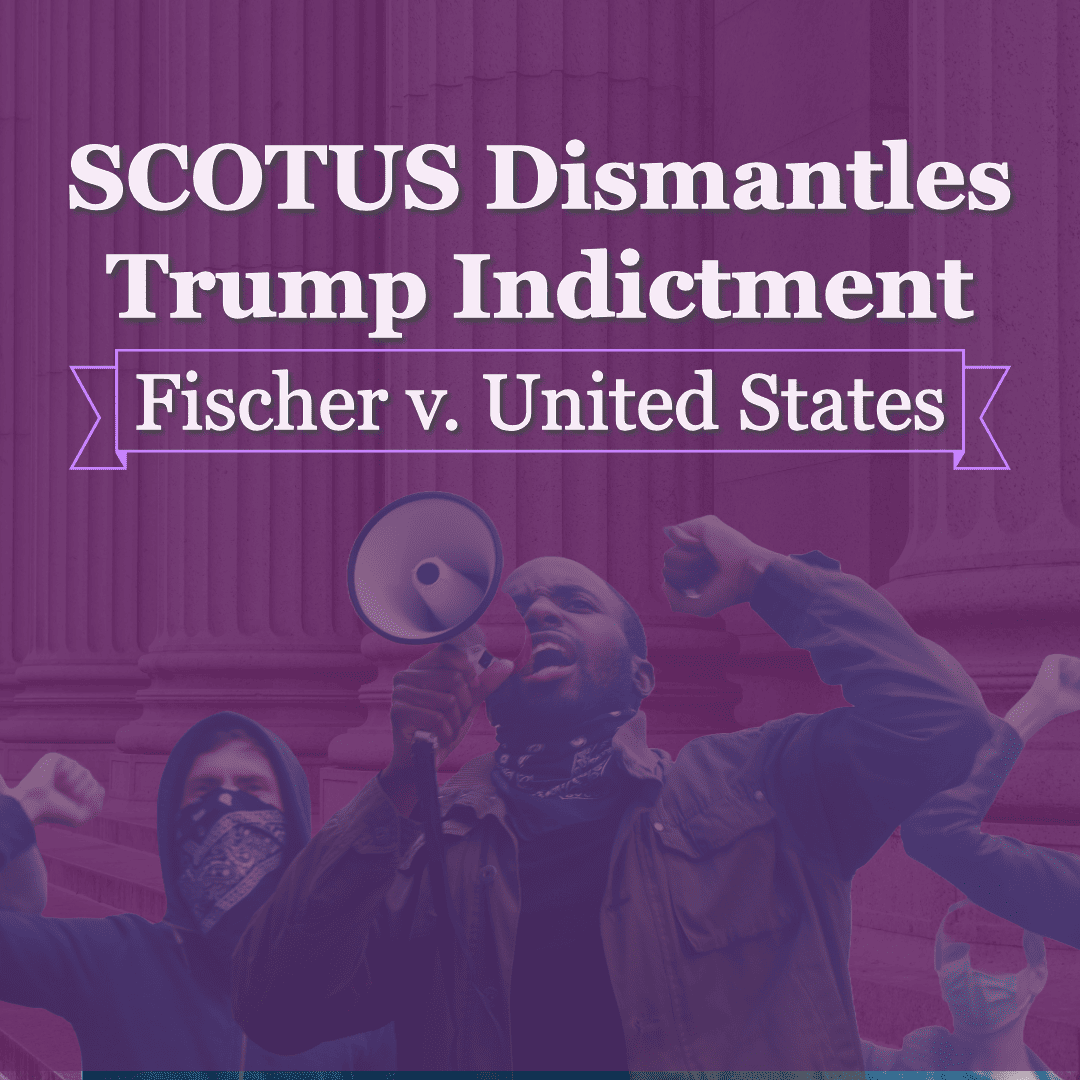
In a significant decision on June 28, 2024, the U.S. Supreme Court ruled in Fischer v. United States, addressing the scope of 18 U.S.C. § 1512(c), a statute initially enacted as part of the Sarbanes-Oxley Act. This statute was intended to combat corporate and financial fraud by prohibiting the obstruction of official proceedings. Joseph Fischer, a defendant involved in the January 6th Capitol riot, challenged the application of this statute to his actions, arguing that it was improperly applied to situations beyond its original intent.
The case rose to prominence as Fischer and other defendants contended that their prosecution under the Sarbanes-Oxley Act should not apply to their conduct during the Capitol riot, asserting that the Act was designed to address financial crimes related to corporate fraud, not political protests or riots .
The Supreme Court, in a majority opinion written by Chief Justice John Roberts, vacated the D.C. Circuit’s ruling and remanded the case for further proceedings. The key takeaway from the majority opinion was the requirement for the government to prove that a defendant’s actions “impaired the availability or integrity of records, documents, or other objects used in an official proceeding.” Roberts emphasized that “Congress does not hide elephants in mouseholes,” underscoring that the statute must be interpreted within the context of its language and legislative history.
Justice Ketanji Brown Jackson concurred with the majority, adding that the interpretation aligns with the principle that statutes should not be extended beyond their clear terms unless the legislative intent unequivocally supports such an extension. Jackson’s concurrence provided additional support to the majority’s narrower interpretation of the statute.
Justice Amy Coney Barrett, joined by Justices Sonia Sotomayor and Elena Kagan, dissented. Barrett argued that the majority’s narrow reading of the statute ignored the broad language chosen by Congress to address a wide range of obstructive behaviors. She expressed concern that the majority opinion required finding “any way to narrow the reach” of the law, potentially undermining its efficacy in addressing various forms of obstruction.
Joseph Fischer was prosecuted for his role in the January 6th attack on the U.S. Capitol, facing charges of obstructing an official proceeding, assaulting a police officer, and disorderly conduct. Fischer and other defendants argued that their actions did not fall within the scope of the Sarbanes-Oxley Act. Initially, District Judge Carl J. Nichols dismissed the obstruction charges, stating that the Act’s provisions were improperly applied. However, the D.C. Circuit Court of Appeals later reversed this decision, leading to Fischer’s appeal to the Supreme Court .
Impact on Donald Trump’s January 6th Indictment
The Supreme Court’s ruling in Fischer v. United States has significant implications for the federal indictment of Donald Trump related to the January 6th events. Trump’s indictment includes charges under 18 U.S.C. § 1512(c) for allegedly obstructing the certification of the Electoral College results. Following the Fischer decision, prosecutors in Trump’s case must now demonstrate that his actions specifically involved tampering with or impairing the integrity of documents or records used in the certification process.
The Fischer decision effectively destroys Jack Smith’s Indictment all but ensuring that, at least the obstruction charge, is going bye bye.
Ronald Chapman II is the founder of Chapman, Dowling & Mallek and a top-rated Michigan federal criminal defense attorney who represents clients in federal courts nationwide. His practice is focused on defending individuals and organizations in complex federal prosecutions, including white-collar criminal matters and healthcare fraud investigations.
Throughout his career, Mr. Chapman has helped clients avoid more than $550 million in potential penalties, primarily in cases involving physicians, healthcare providers, executives, and professionals facing federal charges. He is widely recognized for his work as a Michigan healthcare fraud defense attorney, as well as for his results in white collar criminal defense in Michigan, where cases often involve parallel civil, regulatory, and criminal exposure.

Apr-8-2026
Hospice fraud is a serious enforcement priority for Medicare, and federal regulators are under pressure...
Apr-2-2026
In federal court, some of the most important battles happen after trial—on appeal—where the focus...
Jan-9-2026
Memphis, Tennessee – The verdict returned this week in United States v. Sanjeev Kumar closed...
Dec-31-2025
Dr. Lonnie Joseph Parker, a Texarkana physician, was recently convicted in federal court of unlawfully...
Serving Clients Nationwide.
Chapman, Dowling & Mallek is headquartered in Detroit, Michigan and represents clients in federal investigations and criminal matters across the United States. Our attorneys handle complex federal cases nationwide while maintaining offices in Michigan and other states.
456 E. Milwaukee, Detroit, MI 48202