FDA Warning Letter vs. FDA Form 483: The Difference Can Decide What Happens Next
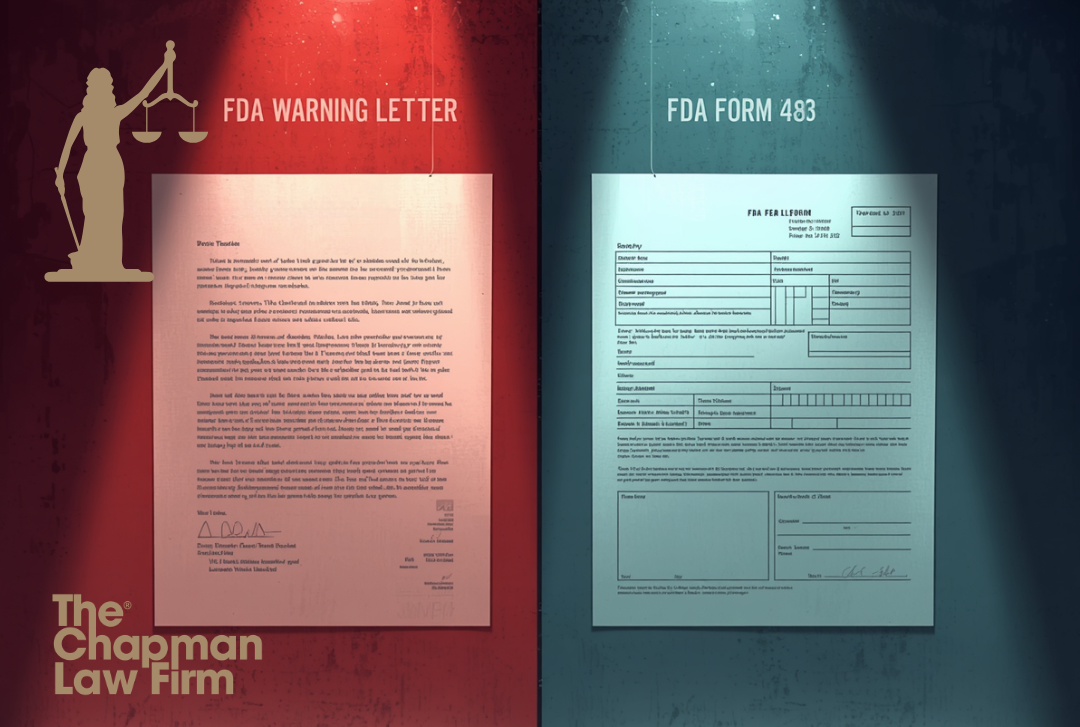
One of the most common questions companies ask after an FDA inspection is this: What is the difference between a Form FDA 483 and an FDA warning letter?
The short answer is that a 483 is generally the inspection-stage document, while a warning letter is a more escalated public enforcement document. But that simple explanation misses the part clients actually care about: the two documents sit at different points on the enforcement timeline, they create different risks, and they call for different kinds of response.
Understanding that difference can help a company act early enough to stop a manageable problem from becoming a much more public and dangerous one.
What is a Form FDA 483?
A Form FDA 483 is issued at the conclusion of an inspection when FDA investigators observe conditions that, in their judgment, may constitute violations. It is discussed with management before investigators leave. It identifies objectionable conditions observed during the inspection.
Just as important, a 483 is not a final agency determination. FDA later considers the 483, the inspection report, the evidence gathered, and the company’s response before deciding what further action—if any—is appropriate.
That means a 483 is best understood as an early-warning inspection document.
What is an FDA warning letter?
A warning letter comes later in the process. It is a formal advisory action used for violations of regulatory significance. It reflects FDA’s view that the issue is serious enough to require a public, written demand for correction.
A warning letter is also not final agency action, but it is more serious than a 483 in several practical ways:
- it is public,
- it is more clearly an enforcement step,
- it often carries a short response window,
- it signals that FDA believes the matter warrants formal notice,
- it can help establish prior warning if stronger action follows.
The simplest way to understand the timeline
Think of the process like this:
Inspection → possible Form 483 → FDA compliance review → possible warning letter → follow-up inspection, recall, import action, injunction, seizure, or criminal referral if the matter is not adequately resolved.
That is not the only path. FDA can escalate without a warning letter in some circumstances. But for many companies, the 483-to-warning-letter sequence is the most important early enforcement pattern to understand.
Why the 483 stage is often the best chance to prevent escalation
Many businesses wait until a warning letter arrives before taking the issue seriously. That is backwards.
The 483 stage is often where the company still has the greatest ability to influence FDA’s view of management credibility, root-cause analysis, and willingness to correct deficiencies voluntarily. A strong 483 response can narrow risk, while a careless one can help create the case for a warning letter later.
This is especially important in drug, biologic, device, compounding, and other CGMP-driven matters where inspection classifications and the company’s response shape what FDA does next.
Why warning letters are different
A warning letter changes the stakes in three major ways.
1. Public exposure
Warning letters are posted publicly. A 483 may eventually become obtainable, but a warning letter is public-facing from the start.
2. Stronger enforcement signal
A warning letter tells the company that FDA believes the violations are significant. It is a much clearer sign of formal agency concern.
3. Greater escalation risk
A poor response to a warning letter can support later action such as reinspection, recall, import problems, injunction litigation, or other enforcement steps.
What to do at each stage
After a Form 483
- preserve documents,
- investigate under privilege,
- correct what can be corrected immediately,
- prepare a detailed, evidence-backed response,
- think ahead to reinspection and classification.
After a warning letter
- do all of the above,
- assume the matter is now part of a public enforcement record,
- coordinate technical, legal, and communications strategy,
- prepare for verification, follow-up inspection, and possible escalation.
Why Ronald W. Chapman II is well suited to advise at both stages
The best time to bring in counsel is not only after the government has escalated. It is when the business still has a chance to control the record.
Ronald W. Chapman II is a former federal prosecutor and U.S. Marine Corps Judge Advocate with an LL.M. in Health Care Law. His practice focuses on defending healthcare professionals and regulated entities in complex federal matters, and his healthcare fraud victories show what it means to fight back when a case becomes high stakes. He also brings healthcare-regulatory experience through compliance, internal investigations, and defense of regulated businesses facing parallel civil, administrative, and criminal pressure.
That background is particularly valuable in 483 and warning-letter matters because the right response has to do two things at once: address the regulatory issue and protect the client if the government decides to push further.
FAQ
Is a 483 worse than a warning letter?
No. A warning letter is generally the more serious step.
Can FDA skip the 483 and go straight to a warning letter?
In some contexts, yes. And FDA can also take enforcement action without a warning letter in certain circumstances.
Should the company use the same response strategy for both?
No. The stages overlap, but the stakes, audience, and tactical posture are different.
Call to action: If your company is trying to understand whether it is still in the inspection stage or already in the enforcement stage, that distinction is exactly where experienced FDA defense counsel adds value.
About the Author
Ronald Chapman II is the founder of Chapman, Dowling & Mallek and a top-rated Michigan federal criminal defense attorney who represents clients in federal courts nationwide. His practice is focused on defending individuals and organizations in complex federal prosecutions, including white-collar criminal matters and healthcare fraud investigations.
Throughout his career, Mr. Chapman has helped clients avoid more than $550 million in potential penalties, primarily in cases involving physicians, healthcare providers, executives, and professionals facing federal charges. He is widely recognized for his work as a Michigan healthcare fraud defense attorney, as well as for his results in white collar criminal defense in Michigan, where cases often involve parallel civil, regulatory, and criminal exposure.