

Understanding federal drug laws
The Controlled Substances Act (CSA)
The Controlled Substance Act, 21 U.S.C. 801 et. seq., placed all substances into one of five schedules. The schedules in order of potential for abuse. Schedule I drugs are drugs that are considered to have no medical use and are illegal to distribute or possess outside of medical specifically approved medical research. Schedules II through V drugs can be prescribed by a doctor who receives a registration through the DEA to prescribe controlled substances. The controlled substances act makes it illegal for a person to possess a schedule II through V drug without a valid prescription and makes it illegal to possess a schedule I drug.
Drug distribution is made unlawful by 21 U.S.C. 841(a) which makes it unlawful to possess, manufacture, or distribute a controlled substance.
Elements of Federal Drug Distribution / Possession
To convict a federal defendant of drug trafficking the Government must prove that the Defendant knowingly distributed a scheduled controlled substance. A defendant cannot be convicted of drug trafficking if the Defendant was unaware that the substance was a scheduled controlled substance. Typically, in order to prove trafficking, the prosecutor will have to prove that the Defendant possessed an amount higher than that regularly used for personal use. Circumstantial evidence can also be used to prove trafficking such as plastic baggies, high amounts of cash or equipment usual found during investigations of drug crimes. There is no set quantity that “automatically” constitutes drug trafficking under federal law. Rather, the Government must prove that the defendant intended to traffick (sell) the controlled substance. When the identity of the drug in question is not immediately apparent, the investigative agency such as the DEA will send the substance to a drug lab for testing. The drug lab will analyze the substance and determine if it is in fact a drug that falls within the DEA’s controlled substance schedules.
Federal Drug Sentencing
A violation of 21 U.S.C. 841 is a felony punishable by up to 20 years in jail but in some cases – such as distribution causing death up to life. A federal judge will determine how high a sentence should be by utilizing the federal sentencing guidelines. The federal sentencing guidelines utilize a figure determined by the weight distributed to determine the sentencing range. A person who distributes a high quantity of drugs is sentenced to a higher range within the 20-year maximum and a person who distributes less is subject to the lower range.
In 2005 the Supreme Court decided United States v. Booker which made the federal guidelines for all federal offenses advisory in nature. This means that defendants sentenced after 2005 could argue at sentencing for a lower sentence utilizing factors outlined in 18 U.S.C. 3553(a). Under 18 U.S.C. 3553(a) a judge is required to sentence a defendant to a sentence that is sufficient but not more than necessary to meet the objectives of federal sentencing. These factors include deterrence, protection of the public, seriousness of the offense and rehabilitation.
Drug Distribution Causing Death
A federal defendant who is indicted for unlawfully distributing drugs that causes serious bodily harm or death of another person must be sentenced to a mandatory minimum of 20 years and could receive a sentence of up to life in prison. This charge is difficult to prove because many drug users overdose from multiple substances often purchased from multiple drug dealers.
In Burrage v. United States, 571 U.S. 204 (201) the Supreme Court determined that a defendant cannot be liable for the penalty enhancement for distribution causing death unless the drug was the “but for” cause of the person’s death. The victim in the Barrage case died after an extended drug binge wherein he ingested marijuana, oxycodone, heroin and other substances. Burrage contested the death count at trial and two medical experts testified regarding the cause of death. One was a forensic toxicologist that determined that multiple drugs were present in the victim’s body. The toxicologist could not say that the victim would have lived had he not injected the heroin. The medical examiner also could not state that the heroin was an independently sufficient cause of death. Burrage moved for acquittal on the grounds that the prosecution could not prove “causation”. He was convicted and the case proceeded to the Supreme Court. The Supreme Court in a unanimous decision overturned the appellate decision and the conviction. The opinion was authored by the late Justice Scalia who expertly parsed out the causation requirement for a death case. As a result of the Burrage decision – the Government must now prove that the drug distributed actually caused the death or serious bodily injury of another.
Ron Chapman has spent his career defending federal defendants in high-profile federal criminal cases. He is also the author of the Amazon best selling book Fight the Feds: Unraveling Federal Criminal Investigations. During his career he has learned that many federal defendants facing the power of the federal government lack resources and understanding of this complex field of law. The book and this companion website and guide were designed to close the informational gap between the federal government and federal criminal defendants by providing tactics and tips learned during my career fighting the federal government and its immense power. If you haven’t already, go to the beginning of this guide and review sections that are relevant to you and consider purchasing Fight the Feds to grow your knowledge of federal criminal law and investigations.
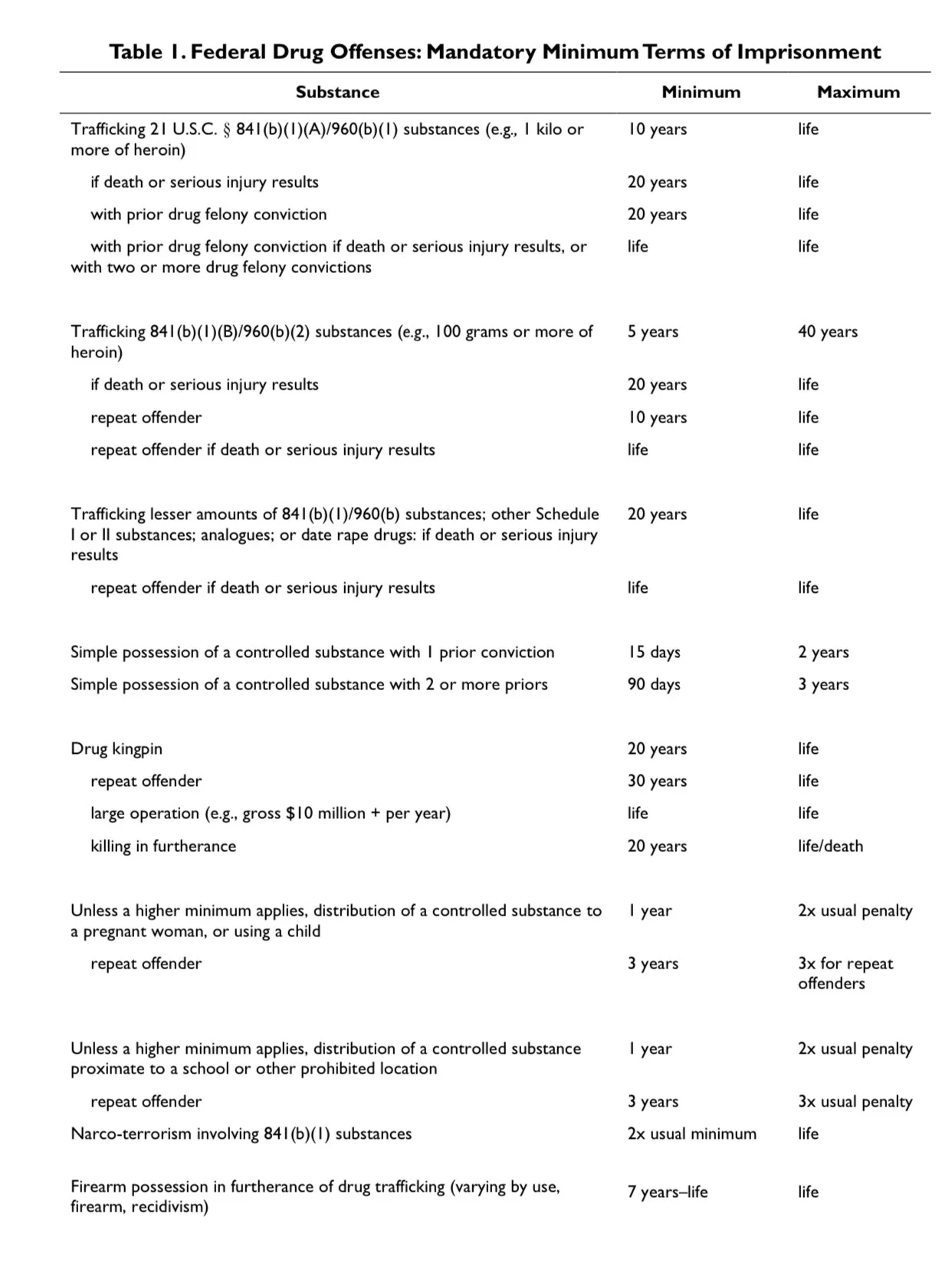 Federal Drug Sentencing Mandatory Minimum Sentences[/caption]
About the Author
Ronald Chapman II is the founder of Chapman, Dowling & Mallek and a top-rated Michigan federal criminal defense attorney who represents clients in federal courts nationwide. His practice is focused on defending individuals and organizations in complex federal prosecutions, including white-collar criminal matters and healthcare fraud investigations.
Throughout his career, Mr. Chapman has helped clients avoid more than $550 million in potential penalties, primarily in cases involving physicians, healthcare providers, executives, and professionals facing federal charges. He is widely recognized for his work as a Michigan healthcare fraud defense attorney, as well as for his results in white collar criminal defense in Michigan, where cases often involve parallel civil, regulatory, and criminal exposure.